Over the last year "ethical conversion optimisation coaching" has been searched often enough to put this website in front of people more than 200 times and if you include the American spelling (optimization) there is another hundred-odd. That surprised me a little as, despite the fact that I am the world's best-known (and yeah maybe the only explicitly) "ethical CRO" practitioner, it is not a phrase I've ever seen anyone else use.
So when I went looking for what those people would have found the answer was a non-specific coaching services page but nothing explicitly explaining what it is.
So, this is what I mean by it.
The short version
Ethical CRO coaching is teaching a team inside a business to do conversion rate optimisation ethically and well on their own. To find out why people don't convert, to test changes properly, to read results without fooling themselves and to get the good ones shipped. They must do this all without reaching for the tricks and hacks that only work by misleading people.
The "coaching" part means we do it on real work, with someone very experienced guiding you alongside, rather than in a classroom setting.
The measure of success is that your teams will become very good independently at the job and will stop needing the coach.
Why coaching rather than just hiring an agency
An agency or consultant will do the work for you. That is by far the largest part of my business and what most people buy from me. It does mean you're likely to continue paying for this service for as long as it keeps delivering, but when our service ends, a lot of what has made the programme work will leave too. The way of interrogating customer needs to drive change, the rigour around evidencing and validating ideas and changes, the instinct for which tests are worth running, the confidence to not get hung up on losing or inconclusive tests and to try and negotiate them into a win. All of that stuff happens when we work together by default, but I do also believe that the best businesses hire this function into their businesses full-time and have it drive results that way. We also do not intend to replace that function in your business if it already exists.
Coaching puts the high knowledge, high skill, long experience and discipline inside your business. Teams who understand why tests were designed the way they were make better judgement calls on everything else they ship. They are embedded with a deep understanding of your customer which then drives their intuition and judgement leading to consistently better decision making.
Why "ethical" is in the name
Because a lot of "CRO training" or "best practice" teaches the tricks as if they were gospel. Fake urgency, fake scarcity, confirmshaming opt-outs ("No thanks, I don't like saving money"), pre-ticked add-ons, removing delivery information because delivery is longer than a user might expect.
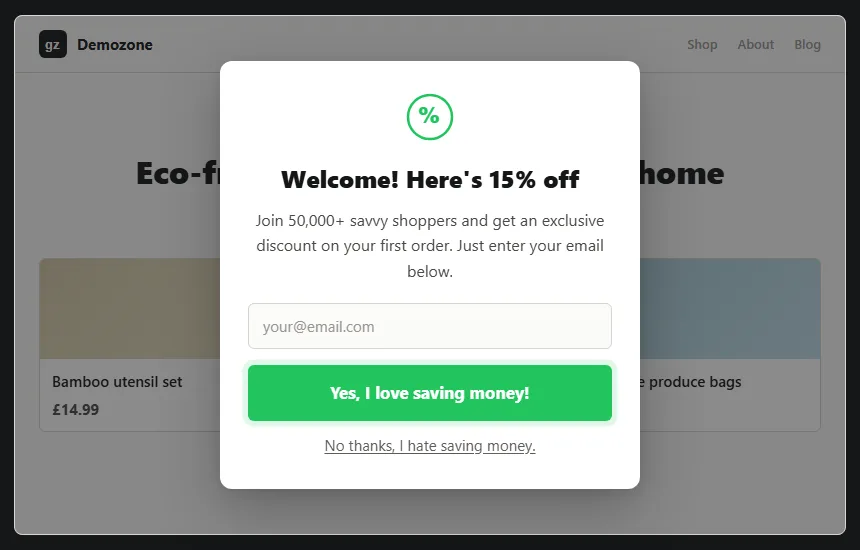
A team that learns CRO from them learns that "optimisation" is how you force more people to do something on the internet.
Many of these tactics are also increasingly illegal. In October 2026 the CMA fined Wayfair £4.8 million over countdown "deals" where the price didn't change when the timer ran out and Appliances Direct £1.2 million partly for pre-ticked "extras" in its checkout. (I wrote about those cases in Unreal deals.) We do not know if these things were tested or just went live, but they're textbook examples of unethical CRO techniques.
There is also a particularly nasty and pernicious little habit in conversion rate optimisation, which is to, frankly, abuse the concepts of popular psychology by dramatically generalising them and then bending them into "here is a recommendation that will work for everyone" which is just categorically not true.
User psychology is frequently cited and misused as evidence for why it will just work. They'll frequently refer to Robert Cialdini, whose 1984 book "Influence" is where a lot of marketers got scarcity, social proof and the foot in the door technique stuff from and to basically all the marketing self-help books that were sold through the 80s and 90s. A lot of what you read now is rehashing that and turning it into the web.
Just as wellness influencer grifters have turned misquoting the Buddha into a sales strategy, so too have bad CRO practitioners turned misquoting Cialdini into a sales strategy.
But consistently, when you test those things, when you actually test them scientifically and accurately, the things that were promised to work don't work. They are either flat, or they sometimes hurt your conversion, or if you measure them on a timeline long enough to understand lifetime value, they harm lifetime value even if they got you some extra early sales.
Say a business decides it needs to fake some urgency to get more purchases. If it doesn't test that, then first of all it just doesn't know. And if it does test it, there's a good chance it finds out that the timer doesn't do anything. Our evidence suggests it doesn't really work for many people at all.
Part of that is because of how common those hacks are. Users are very, very used to seeing them. They aren't novel any more and they aren't believable any more because, my God, everywhere can't be short on stock.
And you don't know that it applies to your business anyway. A business claiming it's running out of dentist appointments is going to see very different behaviour to one claiming it's running out of copies of Grand Theft Auto 6, because those are different products. People probably believe their dental treatment is essential. With GTA 6 you might shop around. You might think "well, I'm still not going to buy now, I'm going to find it somewhere else". It just doesn't unilaterally apply, no matter how often the best practice websites claim that it does.
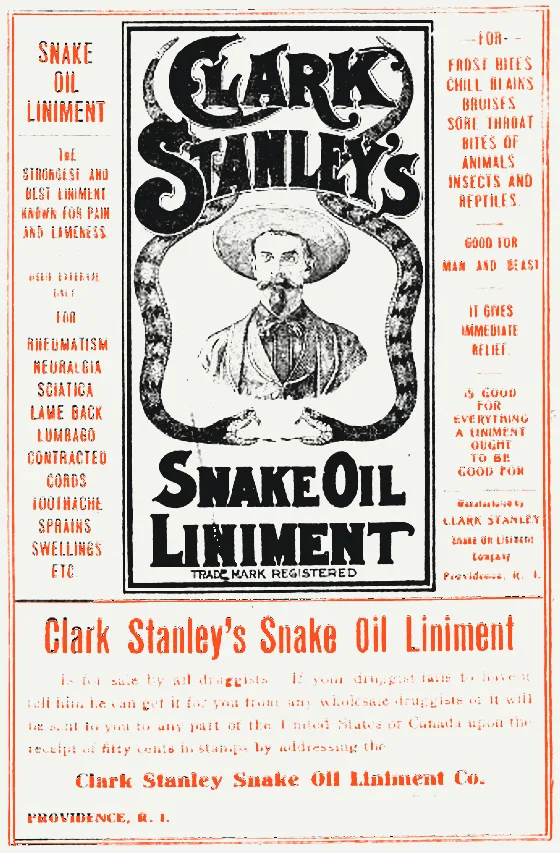
It is snake oil, and it is a snake oil that's easy to sell, which is why there's a lot of it about. The people selling it aren't really required to prove that it works, because all they're selling you is the course or the pre-built landing pages. Sometimes they're not even selling it and it's literally just a best practice article. If you are using an LLM for this advice, a lot of the time it has been trained on those same best practice articles, so even that advice is just rehashing misleading and untested stuff.
When a hack does get you some extra sales, you may well erode your ability to sell in the future, because you've treated people so poorly online. The best customer you can win is a customer who wants to buy from you again and again and who will recommend you to other people when it's appropriate. For example "oh, we use this business, we bought from there, it was really good". To have that, you just can't have your marketing team burning trust and being dishonest with people in such a clear and obvious way that users can point at it and say "wow, you've changed".
What AWIP do that wildly differs from that is we teach you how to understand and build better hypotheses and to build better tests and to really link them to core user needs and behaviour rather than to a hacky, not really well-understood psychological trick. Then what we encourage you to do and build the skills for is to prove it. Make sure it really, actually works in a randomised-controlled trial.
The alternatives tend to be things like clearer pricing, reassurance that is true, fewer steps and better answers to real user needs.
Our Hall of Shame has worked examples of bad patterns and what you can do instead.
What a coaching programme covers
It depends where the team starts but it usually goes through these stages, applied to your site as we go:
- Research. Analytics you can trust, surveys and short user interviews. We are trying to clearly identify a problem before we start designing a solution.
- Hypotheses. Writing them to be falsifiable (so they can be proven wrong) and prioritising based on evidence they might work.
- Test design. Sample sizes, run times and stopping rules all decided before we launch. We'll also cover what to measure besides pure conversion rate, so we can notice when a "win" is costing us returns, complaints or cancellations.
- Building and QA. In whatever testing tool you've got.
- Analysis. Reading results (without peeking or how to avoid peeking) and what to do with flat or negative results.
- Shipping and learning. Getting winners into production, briefing devs effectively so they can scope accurately and keeping a record of what each result taught us so our tests get better and better based on what we learn.
- Spotting deceptive design. In your own site, your competitors' and ideas coming from within the business.
How it runs
Usually it starts with a workshop (£1,000 for a half day, £1,800 for a full day + VAT, see training, coaching and workshops) to get everyone on the same page.
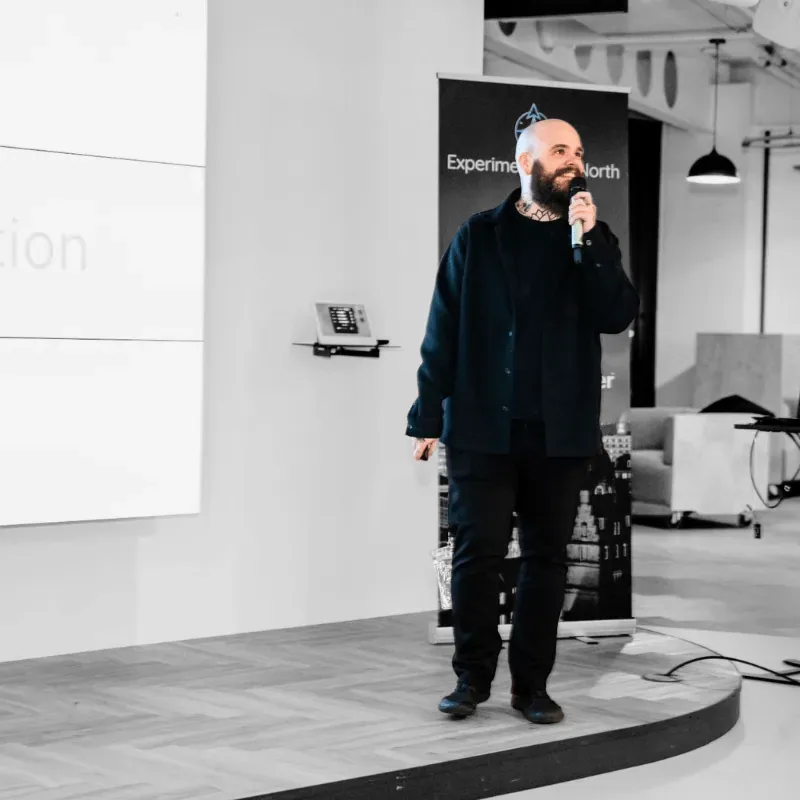
Then the team runs real experiments on their own site with regular coaching sessions: reviewing hypotheses before they're built, test designs before they launch, and analysis before anyone presents it to the board.
Over time I do less and less and the team takes on more. When I'm only nodding along in the review meetings and I have nothing more to teach then we're done.
Who it's for
- In-house teams that have a testing tool and don't feel they're getting much out of it.
- Marketing or product teams who've been told to "do CRO" with no background in it.
- Businesses moving off an agency who want to keep their momentum.
- Anyone who's been told to implement a bad and risky pattern and needs the right language and skills to push back.
If that's you, get in touch.

Jon Crowder runs Another Web Is Possible.